


The Mystery Soundprint Lab
One Sound. One Guess. One Tiny Map of What You Heard.
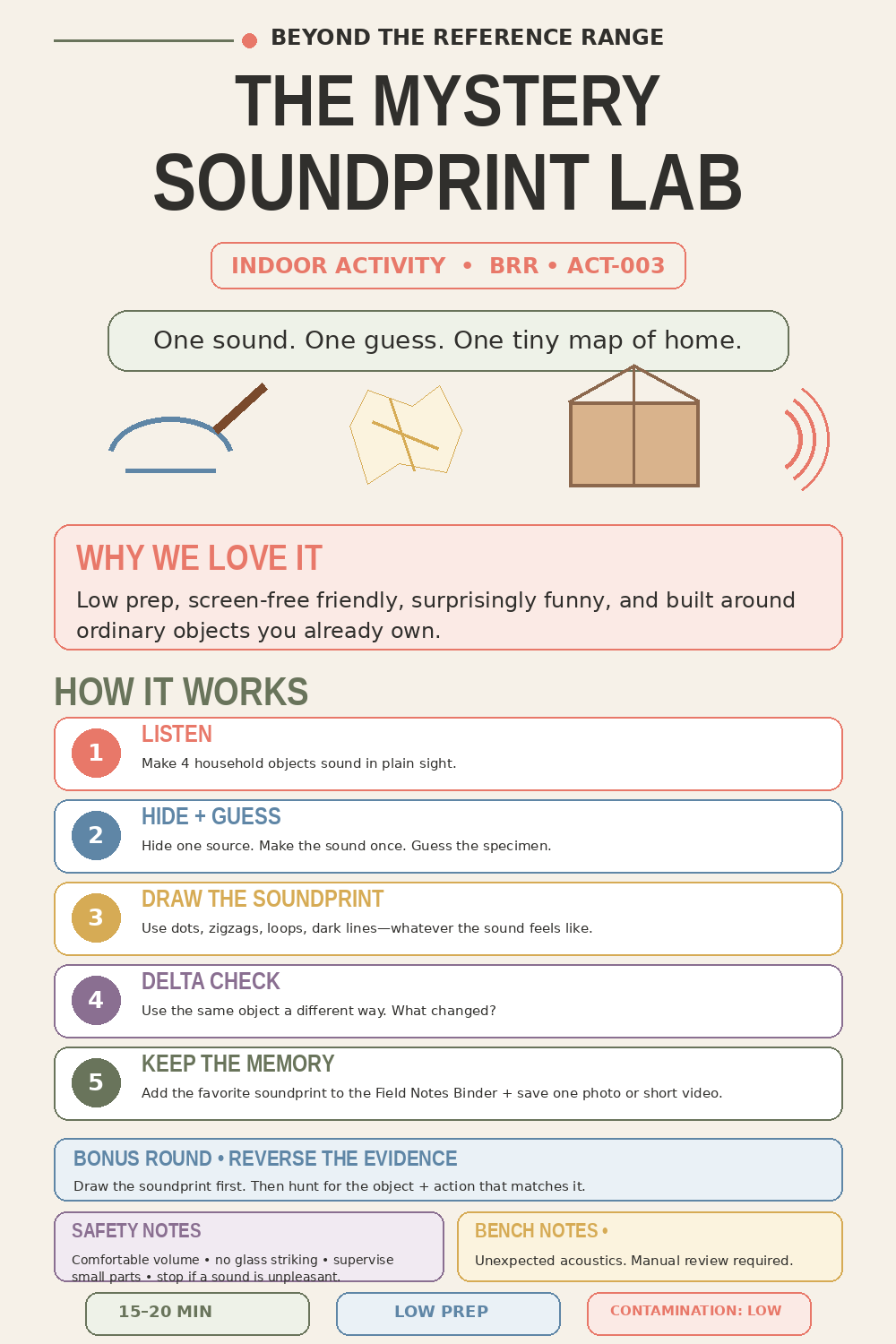
BRR • ACT-003 | Indoor | 15–20 Minutes | Low Prep | Contamination Level: Low | Basically Free
I started thinking about how much of a home we recognize without looking at it.
The click of a cabinet. A spoon against a mixing bowl. Paper being crumpled. A cardboard box dragged across the floor. A dog collar jingling from the next room.
Most of those sounds disappear into the background because they’re always there.
So this time, we’re making them the experiment.
The Mystery Soundprint Lab turns a handful of ordinary household objects into a tiny listening-and-prediction game. We hear them, hide them, guess them, draw what they feel like, and then change one variable to see whether the same object produces a completely different result.
No specialized equipment. No elaborate setup. Very little chance the protocol survives exactly as written.
Which means we’re ready.
MATERIALS:
- 4–6 safe household sound objects
- Something to hide the source
- Family Field Notes Binder
- Pencil/crayons
- Phone/camera for one memory photo or short video
PROCEDURE:
1. LISTEN — Make each object sound once in plain sight.
2. HIDE + GUESS — Hide one source, make the sound, and guess the specimen.
3. DRAW THE SOUNDPRINT — Use dots, loops, zigzags, lines, or scribbles to show what the sound feels like.
4. DELTA CHECK — Use the same object a different way. What changed?
5. KEEP THE MEMORY — Save the favorite soundprint in the Field Notes Binder + one photo or short video.
6. BONUS ROUND: Draw the soundprint first, then hunt for an object + action that matches it.
SAFETY: Comfortable volume • no glass striking • supervise small parts • stop if a sound is unpleasant.
QC PASSES IF:
✅One mystery sound was tested
✅One genuine guess was made
✅One soundprint made it into the binder
BENCH NOTES •
After approximately five minutes, everyone becomes a forensic acoustics specialist.
And suddenly the household has a reference library nobody knew existed.
Unexpected acoustics. Further experimentation required.
WHY I LIKE THIS ONE
There’s something excellent about watching an ordinary object become interesting again.
A mixing bowl stops being a mixing bowl and becomes a specimen with a surprisingly dramatic acoustic profile. Crinkled paper suddenly has texture you can hear. A cardboard box can make several completely different sounds depending on what you do to it.
And nobody needs the “right” vocabulary before they can participate.
If the sound is scritchy, boingy, tiny, angry, sparkly, or “that noise the blue bowl makes,” we have enough data to continue the investigation.
For little kids, pointing, guessing, copying a sound, choosing between two objects, or scribbling a soundprint all count.
For older kids, the same activity can stretch into material, pitch, duration, vibration, or why one action changes the sound of the same object.
FIELD NOTES BINDER
Add the objects you tested, the favorite soundprint, one ridiculous sound-word somebody invented, a question that came up, and a REPEAT? YES / MAYBE / NO marker.
If this becomes a favorite, rerun the lab months later. Same room, different home, different season—whatever life looks like then.
The experiment changes because the soundscape does.
REFERENCES • GO DOWN THE RABBIT HOLE
NIDCD / NIH — How Do We Hear?
https://www.nidcd.nih.gov/health/how-do-we-hear
NIDCD / NIH — Noise-Induced Hearing Loss
https://www.nidcd.nih.gov/health/noise-induced-hearing-loss
American Academy of Pediatrics — The Power of Play
https://www.healthychildren.org/English/family-life/power-of-play/Pages/the-power-of-play-how-fun-and-games-help-children-thrive.aspx
Harvard Center on the Developing Child — Serve and Return
https://developingchild.harvard.edu/key-concept/serve-and-return/
WHAT I’M TAKING WITH ME
A home has a sound vocabulary.
The click, crinkle, thump, jingle, scrape, and tiny noises we stop hearing because they’re always there.
This lab is really just practice noticing them again.
Specimen retained.
Preview PDF
If the preview does not display, open the PDF in a new tab.
A SMALL MARK OF APPRECIATION
No account needed. Tap again to undo.